Episode Transcript
[00:00:10] Speaker A: Welcome to the Outcast.
This is another Colloquium 2026 Spotlight episode where we explore the ideas, research and creative energy shaping this year's ACS Athens Colloquium.
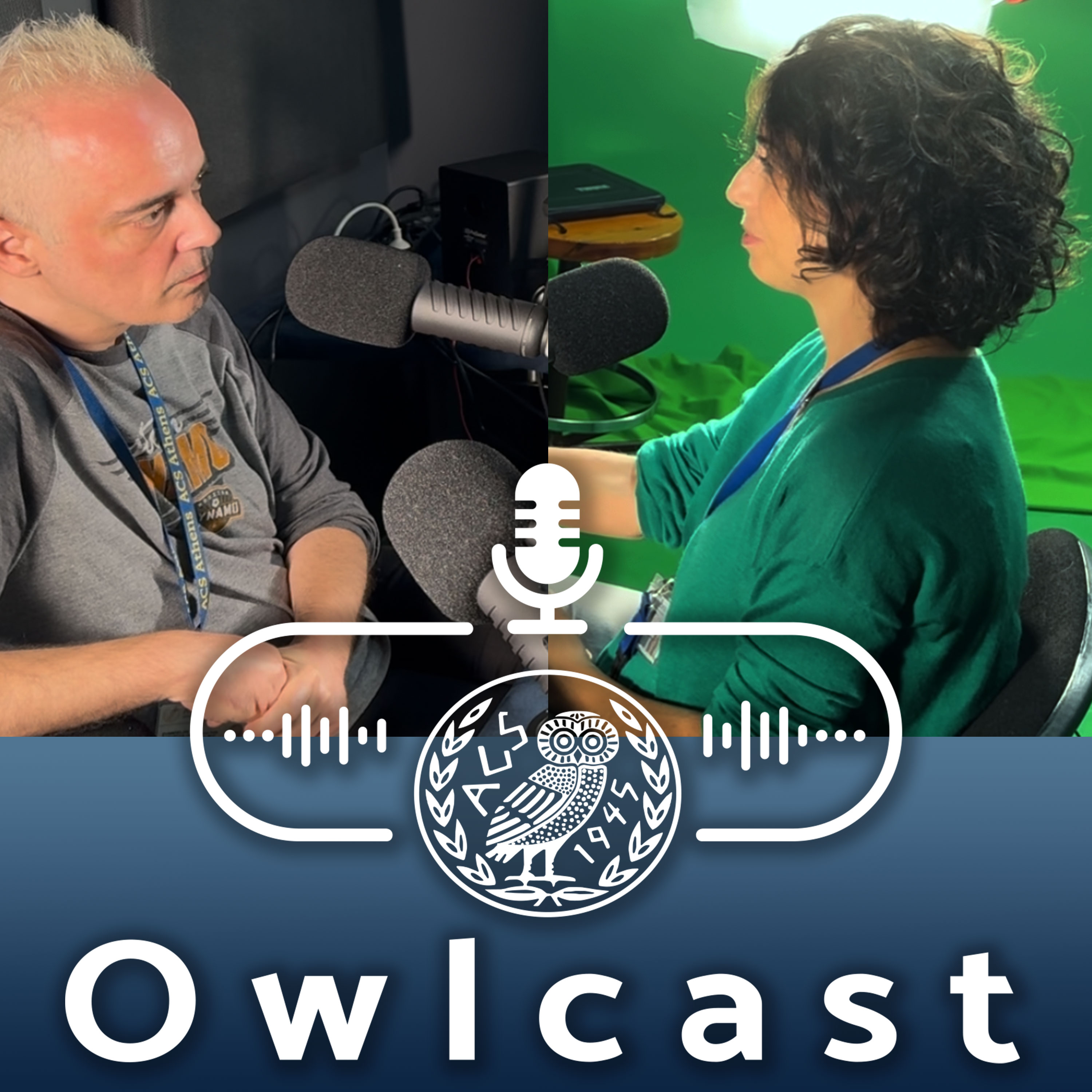
In today's episode, we sit down with Dr. Evan Siropoulos and Sofia Thanopoulou, two faculty members whose action and classroom practice have evolved into a powerful interdisciplinary journey that blends performance, dialogue, empathy and conscious citizenship. Their reflections open a window into what the Colloquium truly a celebration of learning, collaboration and the ongoing transformation of educational practices.
Together, they trace a decade long trajectory of inquiry from devised theatre to developing the inquiry and performance learning model and from class classroom experimentation to large scale collaborations with middle school IB teachers and even external art communities.
What emerges is a dynamic portrait of teaching as both performance and reflective practice. One that constantly adapts, pivots and grows through action research, empathy building and authentic student engagement. Their stories reveal how meta learning comes alive when educators continually learn from their own teaching. We also explore how their work has extended beyond the school walls, informing professional collaborations, conference presentations and a new autoethnographic performance currently running in Athens. As they prepare for this year's Colloquium, Evan and Sophia describe the creative challenges, the evolving research questions and the deep sense of responsibility they feel to bring their learning back to the ACS community. This conversation reflects the heart of the Colloquium, a shared commitment to growth, meaning making and conscious citizenship in an age of rapid change.
[00:02:31] Speaker B: While it's a great honor to participate in the Colloquium and and a huge responsibility because you have to showcase the work that you've done the last five years, you do, all of us do action research, come up with new ideas, we test them and now we show to the world who we really are. It's a great opportunity, as I said, and huge responsibility. What do you think, Sophia?
[00:02:53] Speaker C: I was thinking like you were saying before, how. As you were saying before about the previous colloquium, how this has been for me like a seamless transition from the first colloquium I took part in. And was it 20?
[00:03:06] Speaker B: 18? 16?
[00:03:08] Speaker C: 16.
[00:03:09] Speaker D: It's been, okay, almost 10 years. Okay, it's gonna be 10 years in March.
[00:03:13] Speaker C: 10 years, right. And for me it's like a seamless transition taking over from the work I was doing back then with my students with devising theater and looking how creating original pieces of theater creates the element of assists with the element of citizenship.
And now, as we have been working together with Dr. Sarpolis the last six years, how that work has morphed into what we're doing now, which was. Which is now explicitly.
[00:03:49] Speaker C: Creating performance work and combining it with dialectical work and with a goal to create now to create global, conscious citizens in a very. In a very specific and explicit way. So for me, it has been a seamless transition last 10 years.
[00:04:07] Speaker D: I guess the question that I have could mirror the question of many people who have no idea what a colloquium is.
We talk about it for the past at least 10 years and two years before that and, you know, throughout this period. But we have parents, we have people who are in the school, like new faculty colleagues and so on. How would you. In your. In your words, how would you describe the impact and the actual activity of the colloquium? What do we do in this colloquium?
[00:04:41] Speaker C: You know what I think it is? I think it's a celebration of learning.
[00:04:44] Speaker B: It's a celebration. Yeah.
[00:04:46] Speaker D: So. So what do I. So what do I expect to see?
[00:04:50] Speaker B: Oh, my God. I mean, I try to explain that to my students, right?
[00:04:54] Speaker D: That's what I want to hear.
[00:04:55] Speaker B: They look on my screen and they say, what's this colloquium? Okay, we don't get it. And I say. And then I explain about the whole process of accreditation, the importance of action research, and of course, that this is a showcase and celebration of learning. But what the students don't know is that whatever we do in class every day, it's not only preplanned in the sense that we have our lesson plans, it's actually. Would actually reflect. Reflect on it. Okay, Day after day. Because when you have to do action research, when you have your smart goals, it means from the very beginning of the year, you have an overarching plan. And this plan is, where am I going with my instruction? Where am I going? Where I'm leading my students in terms of their learning and what interventions I'm going to make throughout the year. So this very reflective process that we take for granted.
Okay. I come to realize, I mean, talking with colleagues from other schools and around the world, well, there are not many people there that are doing it. I mean, critically reflecting. And believe me, this is a reflex right now.
[00:06:05] Speaker D: Can you position the reason why other people, other schools don't go into this particular action?
[00:06:13] Speaker B: For me, listen, it has to do what I really appreciated the first. I mean, the first year that was here at ACS amazed me, and it still amazes me. It's that whatever we do here, it's part of our overarching overall philosophy. Let's begin with constructivist, okay, approach to learning, everything begins from there. Okay. We're not just teachers teaching. Okay, don't just teach English. But there is a specific philosophy, educational philosophy, that informs my teaching. And still, since this is the philosophy of the school, and since we're all trained in this philosophy, guess what? We're doing the same thing. So we learn to think in the same way, in a similar way, to experiment in a similar way, to communicate with each other in a similar way and with our students. At the end of the day, now that I'm describing it, it sounds, oh, my God, that's a lot of work. But no, this is how we live, this is how we breathe, this is how we teach, and this is how we learn.
[00:07:11] Speaker C: Sophia, I can't help but thanking the late Steve Medeiros, who, Who was in charge of the first colloquium. And the emphasis has always been, when Steve was around, on tying things together.
And he used to tell us, guys, you're doing this, you're already doing this. You may as well tie the loose ends together and make some meaning out of it. And I think this is what it is for me.
It is an exhibition of, like, our meta learning and say that.
[00:07:44] Speaker C: We teach and we learn at the same time and putting this out there into the world for them to see. How teachers learn from teaching.
[00:07:54] Speaker D: This is a word I'm going to keep. Meta learning.
[00:07:57] Speaker B: It is meta learning.
[00:07:58] Speaker D: We're talking about data and metadata.
We're talking about learning and meta teaching and meta teaching and meta learning. But going back to your classes, Sophia, what are the questions that people may have asked you about? Why is it so important to be involved in this? I mean, I don't know if you're talking with your students about action research.
[00:08:22] Speaker D: But if you do and you get into this discussion, what kind of questions are they asking? How are they involved?
[00:08:28] Speaker C: I guess one particularity of my classes is that I teach performance.
And the whole process of presenting our work as teachers is a performance.
So I think that answers clearly the question students may have. How must. How does performativity help with putting across your message? Well, in every possible way, performativity is all about communicating your. Your ideas, your meaning, making meaning in front of others. So for me, participating in something like this is. Is all about. Is all about putting it. Putting the meaning out there and constructing the meaning out.
[00:09:13] Speaker D: Have you, any of you started already planning your presentations, your showcases? Can you talk a little bit about that?
[00:09:20] Speaker C: We have it, but it changes every five minutes.
[00:09:24] Speaker D: Well, actually, that's the Purpose of action research.
[00:09:26] Speaker B: Right, exactly.
[00:09:27] Speaker D: You see, you evaluate, you pivot, there.
[00:09:29] Speaker B: Are new developments, and of course we're going to discuss them later on that keep on changing our plan. So. Yeah, and thanks so much, Ms. Pappas and Ms. Augustatus, for tolerating this, because we keep on changing our minds. Yes.
[00:09:42] Speaker C: So we started with.
Our initial plan has been the presentation of the learning model that we proposed back in 2022 with the Oedipus Fest, the Inquiry and Performance Learning model, IPLM for short, where we first noticed that, okay, Doc. Evan. Evan had been very well trained with dialectical learning and running Socratic seminars. And I was of course trained in performance.
And we saw how two are a match made in heaven, how you create meaning most effectively when you have students put the two together.
Dialogue and performance and theatrical approach to their, to the content, their. Their learning and then processing this through. Through dialogue and seminar discussions. And so this model kind of morphed over the last, what, three, four years? Four years took many shapes and forms. We did perform performances. We did. We ran projects in class, in the classroom. We did the project with the NASA's foundation and the podcasts, the Myths, the Ancient Myths program.
[00:10:55] Speaker B: We.
[00:10:57] Speaker C: You integrated the whole series of whole anthology of ancient Greek myths into the.
[00:11:03] Speaker B: Sixth grade syllabus and actually totally reconceived, I mean, this year, how we integrate, I mean, the Onassis foundation podcast on Greek mythology and how this could lead to creat and performative work from the students that also incorporates dialogue, reflection and all of that. I want to say any relation. Of course, when we began this, the iplm, it was the year that we actually pushed in our curricula what AI and conscious citizenship. And I think the first thing that we did with Sophia within the Oedipus first is actually we posed the question, what is the role of conscious citizenship in the age of AI, which are the challenges and of course, how we can respond to this, I believe. I mean, hearing you recounting the whole story, I couldn't help but think that what is performance? And why do we use performance? Why do we insist on performance, performing arts in education and especially going deeper and deeper, after all these years of action research, I realized it's one word, it's empathy. It's impossible to teach conscious citizenship if you teach it just theoretically. But then how could I feel the need, okay, to be a conscious citizen? This is developed through empathy. And I think the graduation of Amanda B. That we did in the middle school, which was again, we use the IPLM it was both performance and when engaged, actually the whole middle school, before and after the play, to prepare them for this dialectical questioning, okay, of my identity, of my position in society as what, as a conscious citizen. So I think on the one hand, what we're trying to do with the IPLM is empathy. On the other hand, it's reflection.
So acting consciously through empathy and then reflecting on your own actions.
[00:13:12] Speaker D: And I think that in general, if you think about the education process, teaching is, I guess, one of the ultimate ways of performance, because you have to not only have content, but you have to be able to convey it, you have to communicate it, and you have to make sure that the other person gets it.
So something that is done in not all performances. I mean, there are different ways of art, of course, but, you know, someone who goes to, for example, listen to a jazza ensemble, you don't really sit down and explain to them what improvisation is and what this or that on the musical terms, but you can see that they get it.
So one more point that I would like to ask you to tell us about the collaborations that are going on. I assume everybody is not just in a framework on their own, on a box, on their own, but they are part of a wider, you know, community of teachers and faculty.
And could you talk a little bit about how you took your action research question and you went to your colleagues and you tried to get feedback from them, and then you went back and they. You changed your question or, you know, they gave you ideas of how to focus a little bit more through their lens.
[00:14:33] Speaker B: For me, I mean, what. Because of the very nature of what we did, because actually we mobilized with the Oedipus Fest, the whole academy, actually, the 11th grade and 12th grade classes. Okay. To work on that. And then with the IB teachers. Okay. And then we did that with the middle school, with graduation of Amanda B. That we work with English language arts teachers. I mean, when whatever you do, your action research is actually exposed to so many people as it morphs, okay. As it happens, then immediately you get feedback because they become your own collaborators. Right. I remember one of the best moments of my career is discussing when we're doing the Oedipus Fest. And of course, we brought in not only the English classes, but the TOK classes. Well, IBTOK classes. And I remember we posed some questions so that students would think to prepare for the performance of Socratic seminars. They had to think about AI in relation to conscious citizenship, beginning with Oedipus Rex and ancient Greek culture, and what this Culture has to teach us and see that from a TOK perspective. And I remember that we approached the TOK teachers and then Ms. Hamas Vacuevis brought that to her own class. And she comes out of the class and she brings this huge chart. Not one chart, so many charts with so many ideas from the students. And I say, oh my, I felt so humbled. And then of course you can have a discussion, say what worked? What should we tweak? And I believe when the other colleagues are brought in your, in your own project, your own action research and becomes a collaborative process, I think that's what makes us special here at the CS Athens because that's what we do every day.
[00:16:26] Speaker C: That's another reflex we have, isn't it?
[00:16:29] Speaker C: How open we are and getting, getting bouncing ideas off each other in the halls. Like the discussions with, with other teachers.
[00:16:38] Speaker B: Are usually the most fascinating part of the day, apart from being with the.
[00:16:42] Speaker C: Students beyond tok teachers. I remember Dr. Carab coming in from his own perspective and discussing with his students the AI extension of Oedipus and.
[00:16:56] Speaker D: Which is a whole other chapter. I mean, anything about AI has to be put in a big parenthesis and you know, brackets for another episode.
[00:17:05] Speaker C: Yeah, exactly.
[00:17:11] Speaker C: You are listening to the owlcast, the official podcast of ACS Athens.
[00:17:23] Speaker D: Going forward and looking at what you do in parallel to preparing for the colloquium.
What are some highlights of the year that you envision that's going to happen through your work, through your projects in school?
[00:17:39] Speaker C: I'm looking forward to see how our work of the last year since summer is going to feed back into.
Into this year. Right now I'm currently in the process of working with my, for example for. With my theater class, with my senior theater class on gender stereotypes and seeing how consciousness and citizenship can be approached from that angle. And that is definitely going to feed into our work in the colloquium. At the same time, as always, we engage with the middle school and the devising projects, the applied theater projects that we do with building identity.
[00:18:20] Speaker C: And usually a little play comes out of that. So we are bound to do something with that.
Like last year we involved whole 8th grade drama class in the process drama experiment that we picked up from a conference that we went to and the students culminated into the Voice project that became the.
[00:18:43] Speaker C: How can we use our voice Consciously?
That became the most updated version of our research question.
[00:18:52] Speaker C: So I want to see how this year's classroom work feeds back into, into our. That's why they have to be a little more patient with us.
[00:19:04] Speaker D: Evan?
[00:19:05] Speaker B: Yeah, it's the same for me. Because every year is an adventure, because you have to have your ears open and you be ready to sense where everything is going. Because you begin with an idea, you begin with a question, but you have to tweak, because what we do is interventions, actually. And especially when you do performance, especially when you have to deal with.
With the process of empathizing and reflecting. You have to see, I mean, where the energy is going, the energy in the room. And you have to be able to intervene and change your plans because you really participating into something that I think is sacred. Okay. You have a student, a human mind, a soul. Okay. And what you try to do is show them the way. You're not alone in this world.
Somebody else is next to you. Are you conscious of your presence? Are you conscious of their presence? And what are you doing after you realize that? So, of course you have to change things. Yes. It takes a lot of work. Yes. I mean, you may get frustrated, but in the end, that what keeps us creative, that what keeps us young. And I think our students see that all of us feel young because we always learn. We learn from them and from each.
[00:20:27] Speaker D: Other, and we act as examples all the time.
And since I know that you have so much free time in your day and free time in your.
In general, your life, your weekends. Weekends and everything and nights, you know, there are some exciting things that you do outside the school this year. Okay, so who's gonna give us.
[00:20:50] Speaker B: I'll begin and jump in case of your.
Because what is fun here is that what we're doing here at school, the action research is actually connected to what we're doing outside of school. Because last year with Sophia, we presented our work, our action research, through the World alliance for Arts in Education. It was a summit and participated people from all around the world, both educators and theater professionals. We picked a lot of ideas there and a lot of feedback. I mean, everybody I remember that was mind blown.
Are you doing these things okay in a school? It's a school, really?
[00:21:32] Speaker D: This is a common question.
[00:21:33] Speaker B: It's a common question. Yes, for us. But what happened there? I mean, we came into contact with the local theater community, and they were very much interested in what we were doing. And we explained it to them. There was a certain method. Obviously, you don't build this from scratch. I mean, you have to study, you have to do your research, you have to try things, and you come up with certain theoretical influences, certain practices. And we had the opportunity to further develop them. For example, Sofia, then you did this.
[00:22:05] Speaker C: In Cyprus at the same time, like at the same time as presenting our work to that conference, that summit. We were developing our work with the identities, which was another strand of our research together.
[00:22:20] Speaker C: And I was invited to speak on behalf of both of us to Cyprus, another conference in Cyprus where it was constructing the, the identity of the musical performer. It was a, it was a music education conference and it was all about constructing the, the. The identity of the. Of the music performer. And that's how when things sort of, you know, how sometimes things start colliding together. And then I met this extraordinary researcher, sociologist Mara de Pavlo, who was working on the.
[00:22:56] Speaker C: Autoethnographic method of research, autoethnography, which is telling the story of an individual through a wider social context.
And as if by magic, this artist approached both of us and said, this activist and artist approached both of us and said, I want to do a performance where I want to tell the story of constructing my identity. And it was, was those moments in time when you go like.
[00:23:28] Speaker C: Light bulb. And so we found ourselves, we met this extraordinary individual, this woman activist who has this organization against gender based violence, one of the most kind of active in Greece called Strong Me.
And she has dedicated her life in helping for, you know, to helping women, getting legal help for them, supporting them in every possible way.
And we found her at this breaking point of her career where she. She's also a singer, she's also an incredible artist.
[00:24:02] Speaker B: Yeah.
[00:24:02] Speaker C: And came to this point in her career where she said, I want to tell my story of how I came out of abuse and how I came out of gender based violence.
I want to tell my story of how I want to. I used my past to create my future and to empower, to be empowered by other women. Empower other women and use song to say that, to do that. Now it was just a year away from us doing the energy bus here at Exists, which was exactly that. Telling the story of the community through the eyes of one individual. So it was an auto ethnographic approach before we even knew it was.
[00:24:42] Speaker D: And that generated this performance that you now produce.
[00:24:47] Speaker C: So I even wrote that play that year, Manage Buzz and I directed it and then in the same way approached it and asked us to write a play. So again, Evan wrote the play.
[00:24:58] Speaker D: And so how long have you been involved in this production? If we take away the couple of years that you've been working on the incubation period.
[00:25:05] Speaker B: Yeah, incubation period. I don't. I mean, the first time that that was mentioned Was last November mentioned, but we began working on it a million. I mean for real.
It was around late May, I think. Yeah, the beginning of June.
[00:25:19] Speaker D: Less than half a year.
[00:25:20] Speaker C: Yeah, like six months. Yeah, seriously, six months.
[00:25:23] Speaker B: It was great. I mean, what happened with this performance is everything that we did before. I mean the iplm, our work on empathy, conscious citizenship, reflection, and then auto ethnography. I mean if you want to tell your story from an auto ethnographic perspective and you don't have to be a star or whatever, I mean, I can tell my story, you can tell your story. And that's what makes it great. Because all of a sudden you narrate reflecting on the very structures, social, political, economic, that made you the person that you are right now. So basically you reflect on your life, on the forces that shape your identity. And of course that gives you immense power to change your identity, to evolve, to create a new life for you. So whatever we did all these years led to this moment. So it was a no brainer for us to be involved. But what is great here is because we did it. And of course we felt the huge responsibility now, since we are able to show our work out to the people of Athens. But what as acs, Athens educators and professionals. Because this ACS in a way shaped us, us to be the people that we are right now, the artists that we are right now. So your voice is the way that your voice expresses. So now it's our responsibility, what we get the feedback from out there, I mean from what we're doing here in Athens, how do we bring it back at acs? So that's why we keep on changing the presentation in the colloquium, because we have to figure out the best way, okay, to bring this dimension of our research, how it reached out the city of Athens, Greece in general, and hopefully abroad. And how we can bring that back to our students. And of course, as you can imagine, we have plans for that, what we're going to do.
[00:27:16] Speaker D: So what's the name of the performance and where can people come and see it?
[00:27:21] Speaker C: So in Greek the title is Mira Yenus Thiliku. And I guess the emphasis is on that we can change the destiny.
[00:27:31] Speaker B: Unlike Oedipus.
[00:27:32] Speaker C: Unlike Oedipus, exactly. And it will. It is performed in Theatro Alcmini, downtown Athens. It's in Cato Petralona, near Ghazi.
Every Saturday until. Until December 27th, at 11:30 at night. It's a midnight show. It's.
It's for grown ups.
[00:27:54] Speaker D: Yeah, of course. I Mean, you know, it's. It's a late night performance.
But yeah, this is, I think, very important, what you just said, both of you, that, you know, through the voice that has been formulated in the years that you are in acs, you bring it out, and it's something that culminates into something completely different. Are you planning to have a performance here in the school?
[00:28:17] Speaker C: Absolutely, Absolutely. Totally not the year of the colloquium.
[00:28:22] Speaker B: But definitely there are plans.
There are plans.
[00:28:26] Speaker D: Us, we're looking forward to that. And, you know, I'm probably going to be in the theater before it gets here in the school.
Last question. In general, you're. Without, you know, taking anything out from what you just said, how all this experience, say, the performance that you're directing and you wrote, the work that you did in a colloquium, how does this experience shape you on a personal level, on a more existential level? You are obviously, you know, thinking things deep.
You get things from your past and the present, and you're shaping the future.
So you're. What do we say? Reflective practitioners?
[00:29:11] Speaker B: Listen, I mean, I'm gonna be very simple and brave, and I'm not brave. Usually.
[00:29:17] Speaker B: That'S not one of my strengths. Br But I want to be simple. And this is very heartfelt. I mean, I was not here in the previous colloquium. This is my first experience. I came immediately after September of 2016. And now having this discussion with you guys and reflecting back on the journey that leads to this point, to this colloquium, I would say that being here in this school.
[00:29:43] Speaker B: It gave me the opportunity to really be the person, the man that I was always meant to be. And I really feel it at this moment. And I'm very, very grateful.
[00:29:53] Speaker D: And I'm pretty sure the students receive that.
[00:29:56] Speaker B: Absolutely. They say that all the time. I mean, this is communicating the colleagues or having fun in class with the students. Fun while we're learning, of course. And they say, I mean, all of you here, you look so young. They say that the energy that you have and the passion that we have, this is what it is, is we love what we do and we love the way we're doing it.
And of course, all of us are evolving. That's the most important thing, you know.
[00:30:20] Speaker C: Is the image you have. Like, I have a visual saying this, asking me this question, and it's as if a pebble drops in the middle of the. Of the water and the ripples extend. So everything we do, everything we do together and everything that has happened over the last few years, I feel it's like ripples extending further and further away from the. From the drop to infinity. And I just feel in me this huge expansion of our limitless possibilities. And I have to be honest, this place gives us that.
[00:30:52] Speaker D: And again, don't forget, you're giving me a great image, but I'm going to counter it, because if you drop one pebble, you have one circle being bigger and bigger. But if you have more pebbles, then you see infinite images.
[00:31:07] Speaker B: Exactly.
[00:31:07] Speaker C: Imagine us throwing pebbles at each other all the time.
[00:31:12] Speaker D: It depends on the size of the pebbles.
[00:31:14] Speaker C: There's just not enough hours in the day for.
[00:31:16] Speaker D: I'm pretty sure you're gonna find time if it is throwing pebbles to heaven.
[00:31:20] Speaker C: I think at this point, we are at the point of we're creating time.
[00:31:24] Speaker D: Well, thank you so much, both of you. That has been an excellent discussion, I think.
[00:31:28] Speaker C: John, thank you so much.
[00:31:29] Speaker D: I hope that, you know, our audience and our viewers are going to get something out of what we're trying to do with this year's colloquium. And, Evan, you are in for a treat.
Sophia has seen it, has been in it.
You're the newbie here.
[00:31:48] Speaker B: I'm excited.
I'm a little bit nervous, to be honest.
[00:31:51] Speaker C: He's a pro. He's a pro. He's got this.
[00:31:53] Speaker D: Thank you so much, guys.
[00:31:54] Speaker C: John, thank you for having us.
[00:31:55] Speaker D: Thank you.
[00:31:56] Speaker B: Thank you. Thank you so much.
[00:31:59] Speaker C: You are listening to the OLC, the official podcast of ACS Athens. Make sure you subscribe to the Allcast on Google podcasts, Spotify and Apple podcasts. This has been a production of the ACS Athens media Studio.